




Welcome to Grupo Spurrier
Grupo Spurrier is the leading company in the provision of strategic information on economic and political issues regarding Ecuador, which we monitor through Weekly Analysis and Análisis Semanal. We specialize in economic research, competition advice, market research, business plans, and workshops in economic scenarios and regulatory changes.
Weekly Analysis Briefs
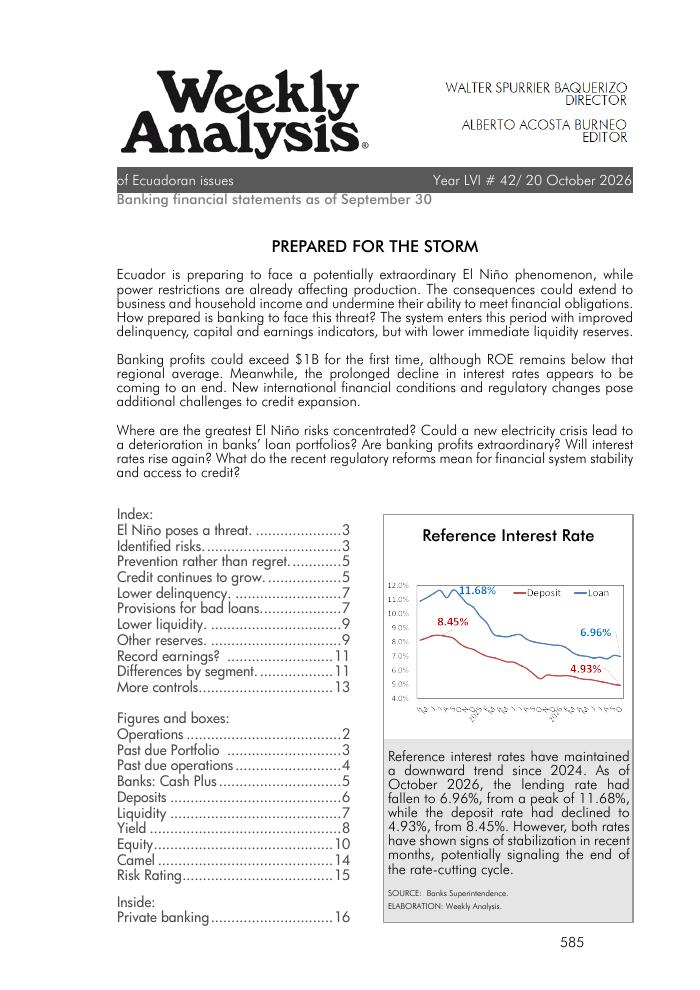
WA-2026-42: PREPARED FOR THE STORM
Ecuador is preparing to face a potentially extraordinary El Niño phenomenon, while power restrictions are already affecting production. The consequences could extend to business and household income and undermine their ability to meet financial obligations. How prepared is banking to face this threat? The system enters this period with improved delinquency, capital and earnings indicators, but with lower immediate liquidity reserves. Banking profits could exceed $1B for the first time, although ROE remains below that regional average. Meanwhile, the prolonged decline in interest rates appears to be coming to an end. New international financial conditions and regulatory changes pose additional challenges to credit expansion. Where are the greatest El Niño risks concentrated? Could a new electricity crisis lead to a deterioration in banks’ loan portfolios? Are banking profits extraordinary? Will interest rates rise again? What do the recent regulatory reforms mean for financial system stability and access to credit?
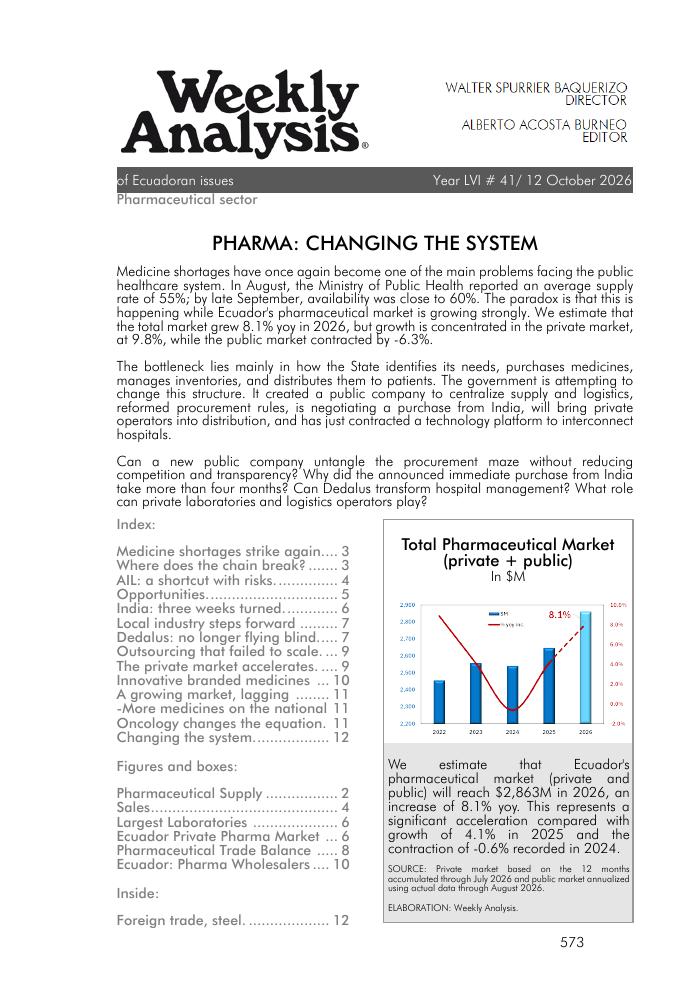
WA-2026-41: PHARMA: CHANGING THE SYSTEM
Medicine shortages have once again become one of the main problems facing the public healthcare system. In August, the Ministry of Public Health reported an average supply rate of 55%; by late September, availability was close to 60%. The paradox is that this is happening while Ecuador's pharmaceutical market is growing strongly. We estimate that the total market grew 8.1% yoy in 2026, but growth is concentrated in the private market, at 9.8%, while the public market contracted by -6.3%. The bottleneck lies mainly in how the State identifies its needs, purchases medicines, manages inventories, and distributes them to patients. The government is attempting to change this structure. It created a public company to centralize supply and logistics, reformed procurement rules, is negotiating a purchase from India, will bring private operators into distribution, and has just contracted a technology platform to interconnect hospitals. Can a new public company untangle the procurement maze without reducing competition and transparency? Why did the announced immediate purchase from India take more than four months? Can Dedalus transform hospital management? What role can private laboratories and logistics operators play?
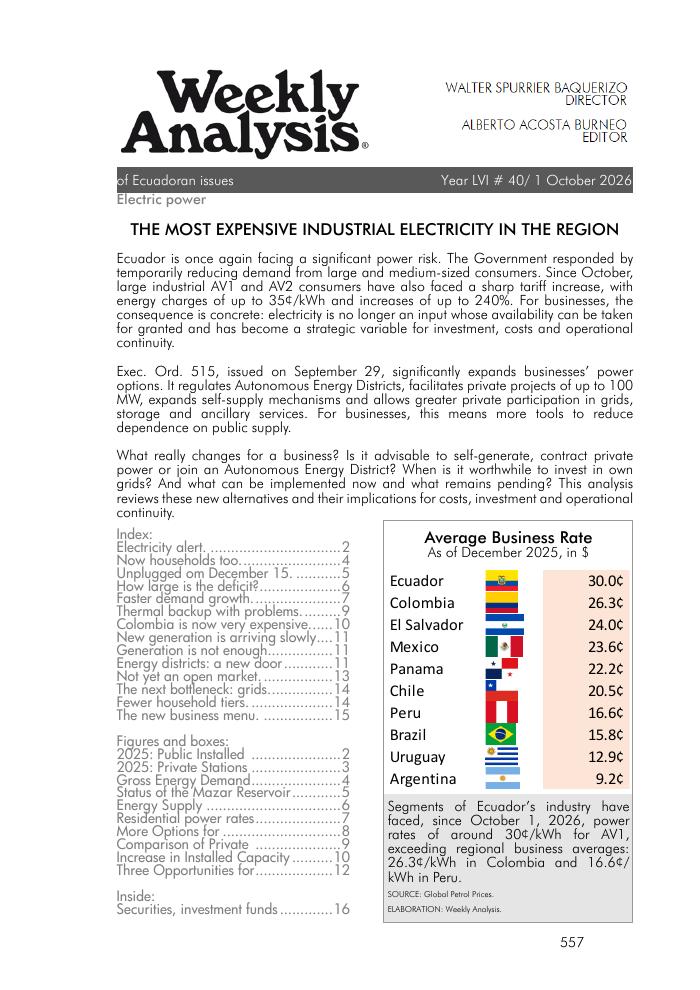
WA-2026-40: THE MOST EXPENSIVE INDUSTRIAL ELECTRICITY IN THE REGION
Ecuador is once again facing a significant power risk. The Government responded by temporarily reducing demand from large and medium-sized consumers. Since October, large industrial AV1 and AV2 consumers have also faced a sharp tariff increase, with energy charges of up to 35¢/kWh and increases of up to 240%. For businesses, the consequence is concrete: electricity is no longer an input whose availability can be taken for granted and has become a strategic variable for investment, costs and operational continuity. Exec. Ord. 515, issued on September 29, significantly expands businesses’ power options. It regulates Autonomous Energy Districts, facilitates private projects of up to 100 MW, expands self-supply mechanisms and allows greater private participation in grids, storage and ancillary services. For businesses, this means more tools to reduce dependence on public supply. What really changes for a business? Is it advisable to self-generate, contract private power or join an Autonomous Energy District? When is it worthwhile to invest in own grids? And what can be implemented now and what remains pending? This analysis reviews these new alternatives and their implications for costs, investment and operational continuity.
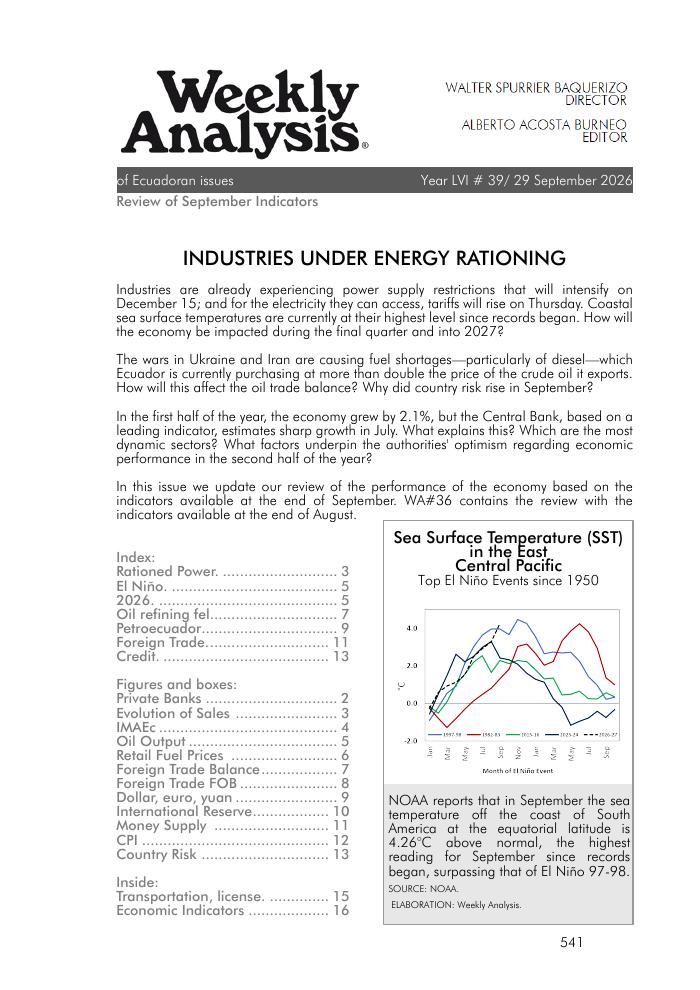
WA-2026-39: INDUSTRIES UNDER ENERGY RATIONING
Industries are already experiencing power supply restrictions that will intensify on December 15; and for the electricity they can access, tariffs will rise on Thursday. Coastal sea surface temperatures are currently at their highest level since records began. How will the economy be impacted during the final quarter and into 2027? The wars in Ukraine and Iran are causing fuel shortages—particularly of diesel—which Ecuador is currently purchasing at more than double the price of the crude oil it exports. How will this affect the oil trade balance? Why did country risk rise in September? In the first half of the year, the economy grew by 2.1%, but the Central Bank, based on a leading indicator, estimates sharp growth in July. What explains this? Which are the most dynamic sectors? What factors underpin the authorities' optimism regarding economic performance in the second half of the year? In this issue we update our review of the performance of the economy based on the indicators available at the end of September. WA#36 contains the review with the indicators available at the end of August.
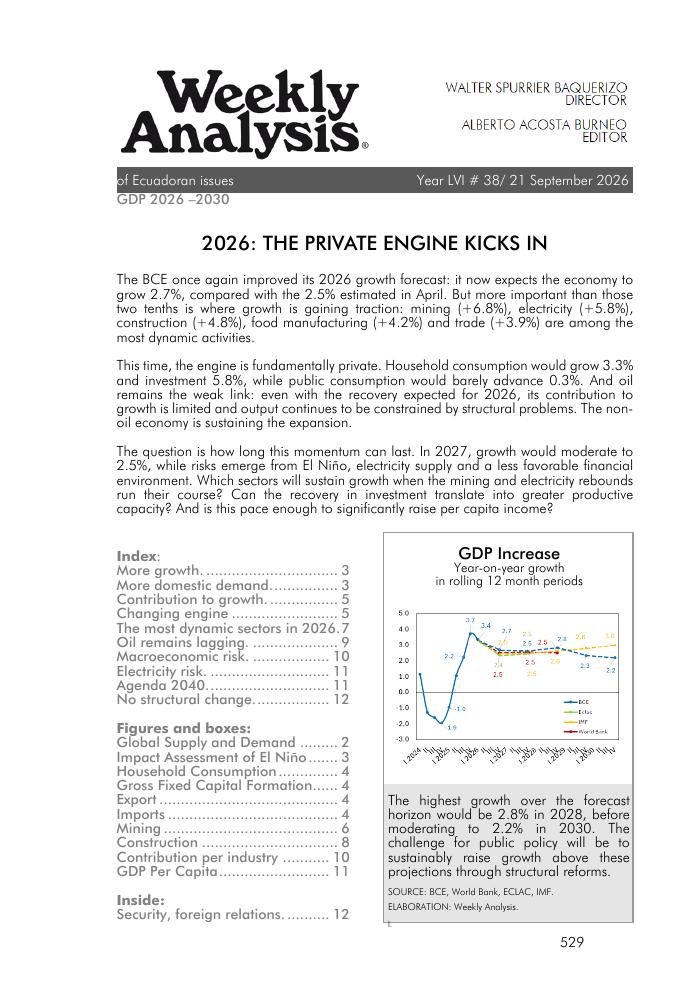
WA-2026-38: 2026: THE PRIVATE ENGINE KICKS IN
The BCE once again improved its 2026 growth forecast: it now expects the economy to grow 2.7%, compared with the 2.5% estimated in April. But more important than those two tenths is where growth is gaining traction: mining (+6.8%), electricity (+5.8%), construction (+4.8%), food manufacturing (+4.2%) and trade (+3.9%) are among the most dynamic activities. This time, the engine is fundamentally private. Household consumption would grow 3.3% and investment 5.8%, while public consumption would barely advance 0.3%. And oil remains the weak link: even with the recovery expected for 2026, its contribution to growth is limited and output continues to be constrained by structural problems. The non-oil economy is sustaining the expansion. The question is how long this momentum can last. In 2027, growth would moderate to 2.5%, while risks emerge from El Niño, electricity supply and a less favorable financial environment. Which sectors will sustain growth when the mining and electricity rebounds run their course? Can the recovery in investment translate into greater productive capacity? And is this pace enough to significantly raise per capita income?
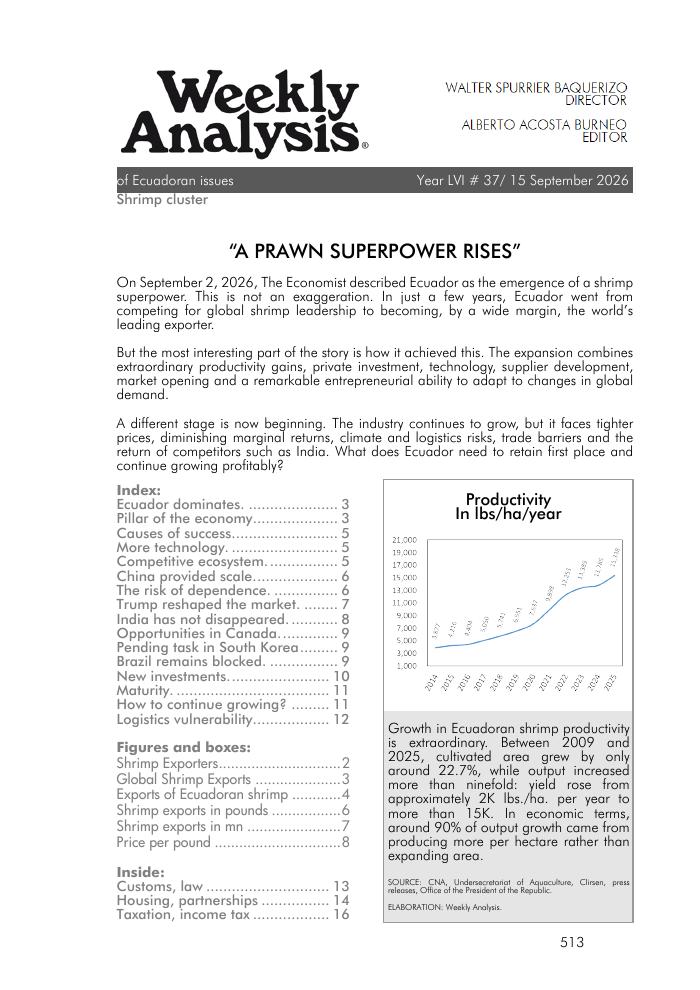
WA-2026-37: “A PRAWN SUPERPOWER RISES”
On September 2, 2026, The Economist described Ecuador as the emergence of a shrimp superpower. This is not an exaggeration. In just a few years, Ecuador went from competing for global shrimp leadership to becoming, by a wide margin, the world’s leading exporter. But the most interesting part of the story is how it achieved this. The expansion combines extraordinary productivity gains, private investment, technology, supplier development, market opening and a remarkable entrepreneurial ability to adapt to changes in global demand. A different stage is now beginning. The industry continues to grow, but it faces tighter prices, diminishing marginal returns, climate and logistics risks, trade barriers and the return of competitors such as India. What does Ecuador need to retain first place and continue growing profitably?